Admission Open For 2025-2026


Admission Open For 2025-2026
Admission Open For 2025-2026


Staff Writer: Upasana Sen
Last Updated: January 16, 2026
| Synopsis: CMAT is considered tougher than MAT, but MAT has more questions in less time. CMAT offers wider acceptance across AICTE-approved colleges, while MAT allows multiple attempts annually. Both exams have similar syllabi but differ in difficulty, exam pattern, scoring, and acceptance among B-schools. |

When MBA aspirants look for alternatives to CAT, MAT and CMAT emerge as the most popular options. Many candidates attempt both exams, while others prefer choosing just one based on factors such as difficulty level, exam pattern, acceptance, and frequency. A common question among students is whether MAT is tougher than CMAT or vice versa. While both are national-level management entrance exams, they differ significantly in structure and level of challenge.
In terms of difficulty, CMAT is considered tougher than MAT. However, MAT poses a different challenge – more questions in less time. CMAT consists of 100 questions to be attempted in 180 minutes, whereas MAT has 120 questions to be solved in 150 minutes. This makes time management more demanding in MAT. One major advantage of MAT is that it is conducted multiple times a year, allowing candidates to improve their scores across attempts. CMAT, on the other hand, is conducted only once annually.
Acceptance also plays a key role in exam selection. CMAT scores are accepted by all AICTE-approved colleges, including government and private institutes, while MAT scores are primarily accepted by private B-schools. As a result, CMAT offers wider college acceptance, whereas MAT provides more flexibility in attempts.
MAT is conducted by the All India Management Association (AIMA), while CMAT is administered by the National Testing Agency (NTA). MAT is held four times a year in multiple phases, whereas CMAT takes place once annually. MAT scores are accepted by 800+ MBA colleges, while CMAT is accepted by over 1,300 B-schools across India. Eligibility criteria for both exams are similar, allowing graduates or final-year students from any stream to apply.
The application fee for MAT is ₹2,200 for one session and ₹3,800 for two sessions. CMAT charges ₹2,500 for General male candidates, ₹1,250 for General female candidates, and ₹1,250 for SC/ST/PwD candidates.
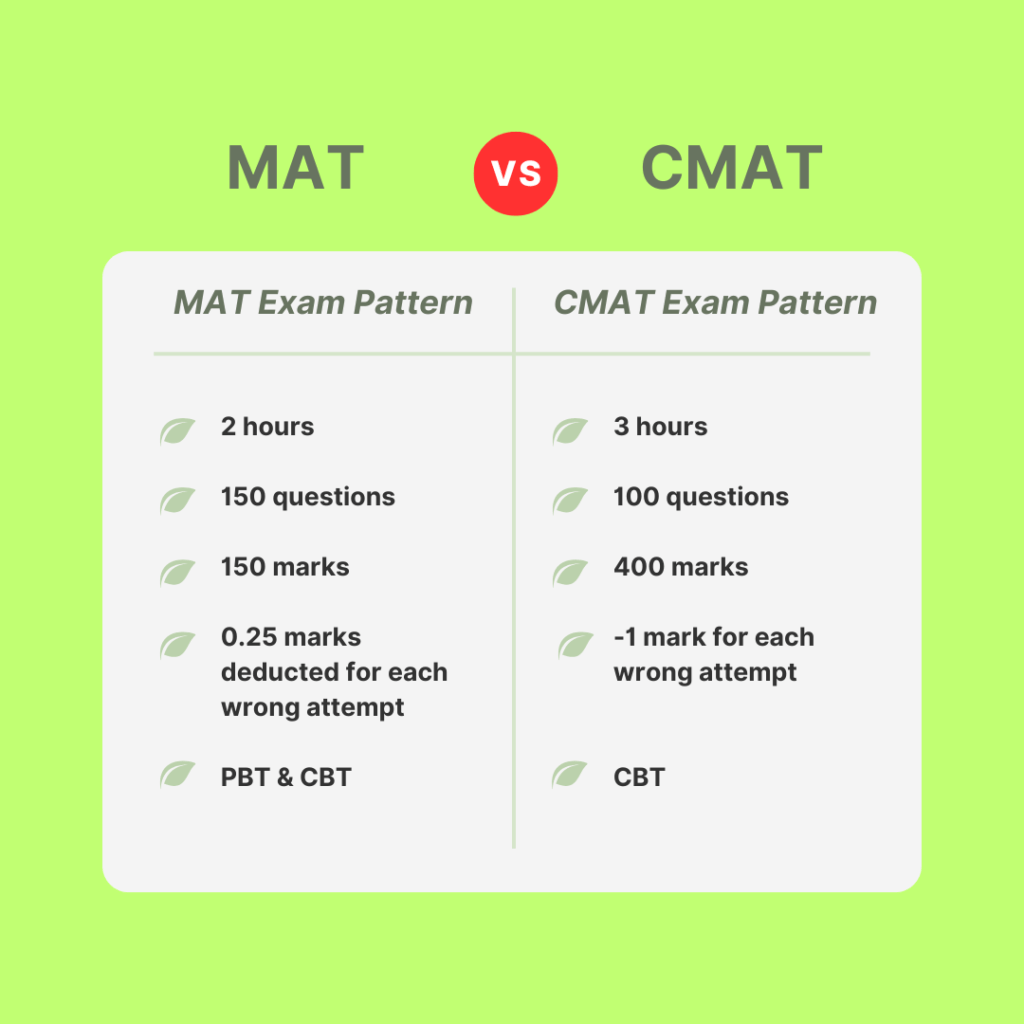
MAT and CMAT differ considerably in their exam patterns. MAT is conducted in both Paper-Based Test (PBT) and Computer-Based Test (CBT) modes with a 2-hour duration. CMAT is conducted only in CBT mode with a 3-hour duration, usually across two shifts.
MAT is generally rated easy to moderate in difficulty, while CMAT ranges from moderate to difficult. Both exams have five sections and no sectional time limits. MAT includes 150 questions carrying 150 marks, with 0.25 negative marking for wrong answers. CMAT has 100 questions carrying 400 marks, with –1 mark negative marking.
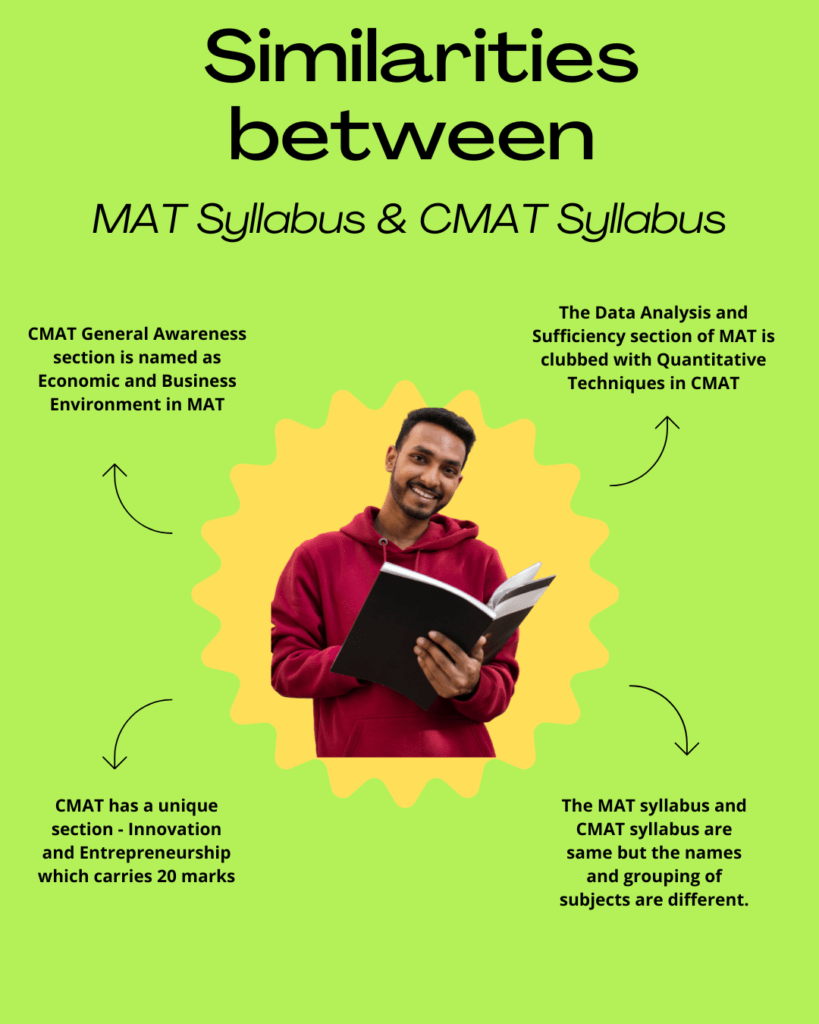
The syllabus of MAT and CMAT is largely similar, though section names and topic grouping vary. MAT’s Economic and Business Environment corresponds to CMAT’s General Awareness section. Data Analysis and Sufficiency in MAT is combined with Quantitative Techniques and Data Interpretation in CMAT.
CMAT also has a unique section – Innovation and Entrepreneurship, carrying 20 marks, which is not present in MAT. Both exams cover core topics such as quantitative aptitude, logical reasoning, language comprehension, and data interpretation, along with current affairs and business awareness.
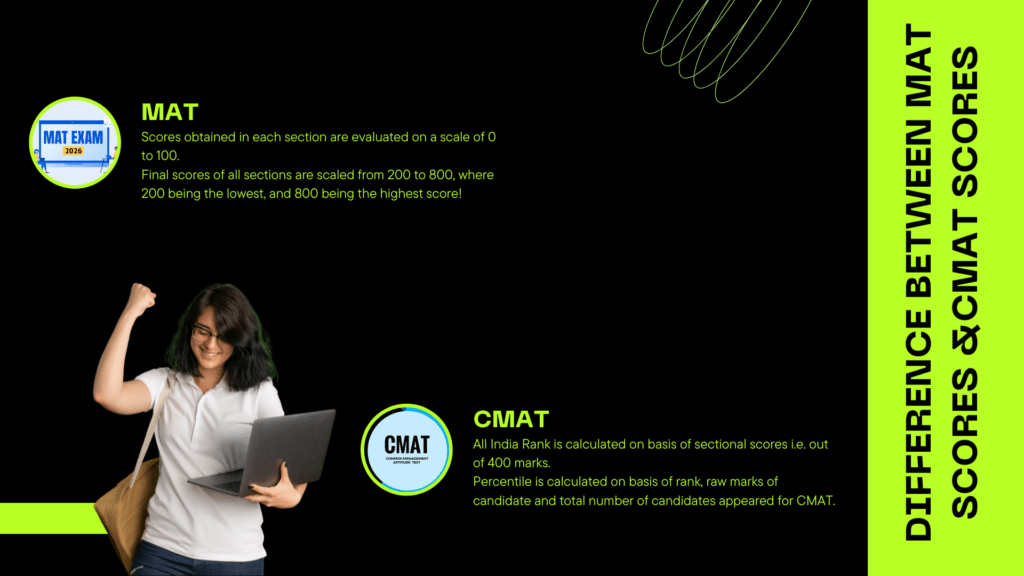
The MAT scorecard provides sectional scores, overall score, percentile, and composite scores. Scores are scaled between 200 and 800, with the Economic and Business Environment section excluded from percentile calculation.
The CMAT scorecard includes section-wise scores, sectional and overall percentile, total score, and All India Rank (AIR). Percentiles are calculated based on rank, raw scores, and total candidates, with the General Awareness section excluded from percentile calculation.
While CMAT is tougher in terms of difficulty, MAT challenges candidates with speed and volume of questions. CMAT offers wider acceptance, whereas MAT provides multiple attempts in a year. The ideal choice depends on a candidate’s strengths, time management skills, and target colleges.